Monday, 13 May 2013

WHEN HARRY MET BESS


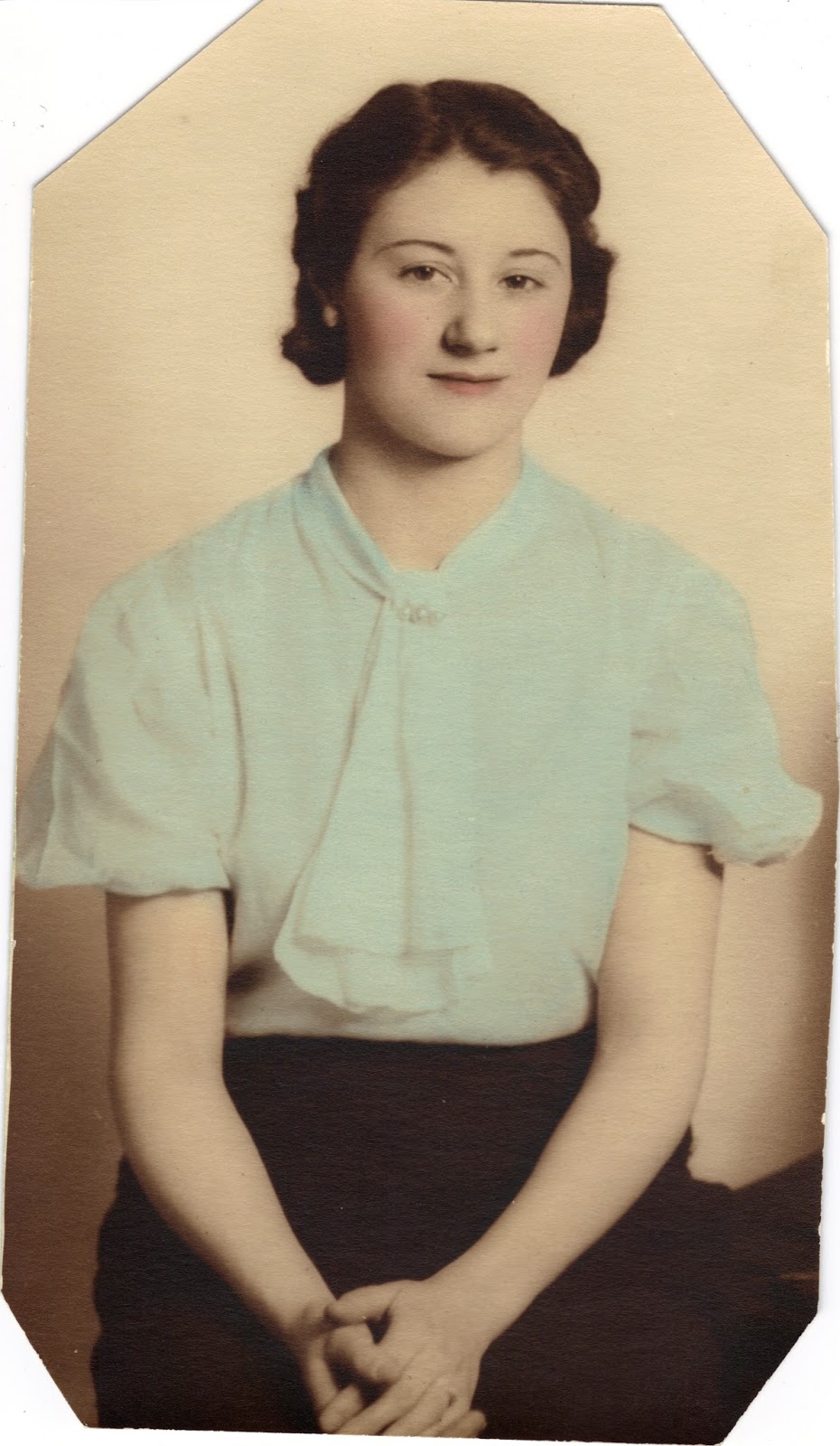
Harry Lewis Welch
Elizabeth (Bess) Blaney told her niece that she had met the man she would marry while they were both working for the same family. She was the baby nurse and Harry Welch was the family chauffeur. In one of her journals she described it as "love at first sight".

Bess started her working life pretty young, as was common amongst working class families of the early 1900s. I remember my Dad telling me he began working at the age of twelve in Sheffield, England in 1924.While the 1911 census tells us Bess was a pinafore machinist at the age of fourteen; she spoke more often of being a baby nurse at the age of sixteen. She was in service to two affluent families in Birmingham between 1913 and 1915.

Firstly, there is a photo in her album which she had labelled “Age 16 - Clive Weaving”. I found that the England and Wales Civil Registration for the period July to September 1913 shows a record of the birth of a Clive Weaving born in King’s Norton, England. Bess would have been just over age sixteen then.

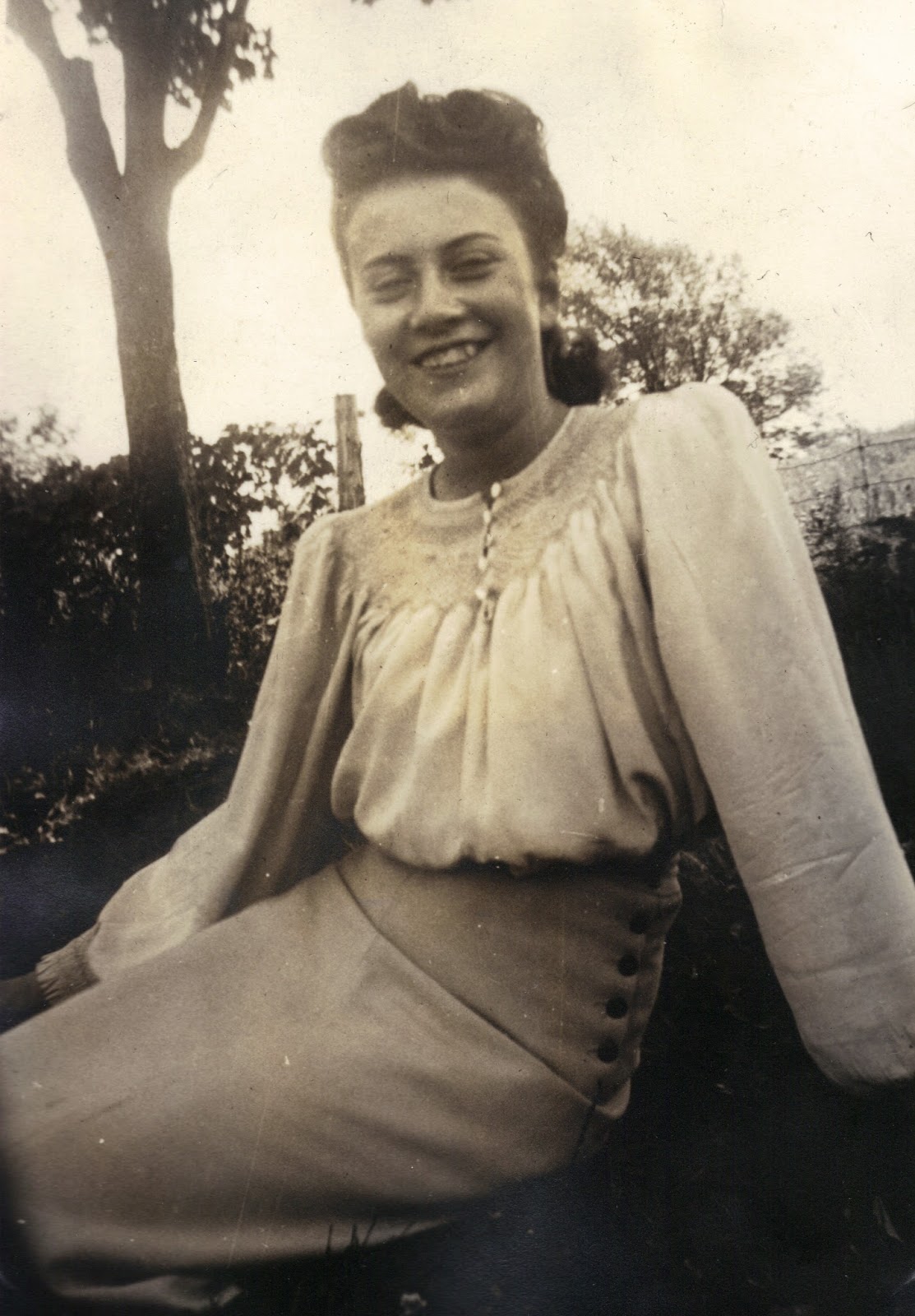
Bess with Clive Weaving
She also wrote about a position she had acquired with the help of her namesake and paternal grandmother, Elizabeth (Langley) Blaney. Bess’ grandfather, Edwin Blaney had died quite young, leaving his widow Elizabeth with five children to raise. She became well known in Birmingham amongst “well to do people” working as a dressmaker. Young Bess was an accomplished seamstress herself, making silk cushion covers for her grandmother from dress fabric remnants.

Bess described herself as about seventeen when she “went into service in a rich house who granny served for”. This would likely have been in the spring of 1915 shortly before her grandmother died at the age of seventy-seven. 

Bess proudly told the story of going into the Lewis (whom she described as being "of the gun family") home and being surprised to see a picture of her grandfather in a top hat and long coat, standing by a horse saddle that was on a stand.The saddle had been made by her grandfather, Edwin Blaney, for Queen Victoria, while he was in the employ of Lamplugh and Brown, a saddle company at 135 Great Colmore Street in Birmingham. According to the London Gazette, August 26, 1891, Lamplugh and Brown was dissolved when Mr. Brown retired. Subsequently, James Alfred Lamplugh formed Lamplugh and Co merging with Middlemore Saddles in 1896.

Mrs. Lewis was Agnes Bertha Brown (born 1871), the daughter of George Frederick Brown (born 1842) who was a wholesale saddler according to the 1891 census. In 1892 she married Ernest Charles Lewis (born 1868) who was a gun maker as was his brother and their father before them. Their youngest daughter Hiliary was baptized April-June 1915 in King's Norton. The other children in the Lewis family were Ernest age 22, Hilda age 19 and George age 13.

I don’t know how Harry Welch came to work as a chauffeur for the family between 1911 and 1915 but I do know that throughout his life he was mechanically inclined and he liked motorcycles and automobiles.

By 1900, the first all-British 4-wheel car was designed and built by Herbert Austin in Birmingham.Only the wealthy could afford the first automobiles and they generally employed a chauffeur rather than driving themselves. The chauffeur usually lived on the property receiving board and lodging in addition to his pay. He drove, cleaned and maintained the car and needed mechanical skills to deal with the breakdowns and tire punctures that were common in the earliest years of the automobile.

Some bicycle manufacturers moved on to building motorcycles and by 1902 there were three companies in England producing them. Harry would go on to serve with the Army Service Corp in WWI as a courier driving a “Trusty" Triumph motorcycle, the chosen vehicle of the Allied Troops at that time.

Harry Lewis Welch was born at 187 Heneage Street in the Aston district of Birmingham on March 30, 1893. He was from a much smaller family having only one sibling, a sister Amy who was born April 11, 1897. She was almost the same age as Bess.
Harry and Amy’s parents were Harry Welch (b. January 4, 1871-1946) and Mary Ann Lewis (b. 1871-1955) who were married in Aston June 12, 1892. I have not researched his mother's Lewis family broadly enough to determine if perhaps a family connection is the link to Harry's employment as a chauffeur. 

In 1911 the family was living at 316 Park Rd in the Hockley area of Birmingham, about ten miles north of the Blaney home in King’s Norton. His father and mother were both age forty, Harry was eighteen, his sister Amy was thirteen and his uncle, Thomas Lewis, was shown as a twenty-eight year old boarder. Thomas was the brother of Mary Ann and had been living with the family since at least 1901 at which time David Lewis, another brother of Mary Ann's, had also boarded with them. In 1911 Harry, his father and his uncles were all brass workers. Harry and his uncle Thomas were both brass hinge dressers and as such they would have worked in a foundry removing the flash and other unwanted bits from the brass castings of hinges.
 
Harry’s grandparents were William Andrew Welch (b 1835-1890) and Mary Ann Barnes (b. 1835-1905). They had five children so he had a couple of uncles on his father’s side of the family as well as those on the Lewis side. Harry did not know his grandfather William who was a bricklayer and died before Harry was born but his grandmother Mary Ann lived until 1905.

It was common in the Welch and Lewis families for adult siblings to live together. For example, in 1891 Harry’s father was living with his sister Polly and his future wife, Mary Ann Lewis. The census showed Polly’s profession or occupation to be “umbrella furniture”- an interesting occupation. Mary Ann Lewis was shown as a lodger working as an ammunition worker. Harry’s father and Mary Ann Lewis were both aged twenty at the time and would be married a year later. There was also a child, Lizzie Welch age 9, in the household who oddly, was shown as a granddaughter of the head of the household, the single, twenty five year old Polly. Lizzie is shown as born in Aston but I have yet to determine who Lizzie’s parents were.

Harry was likely a dashing figure to the eighteen year old Bess; a little older, with a good job, fun loving with a good sense of humour and driving a motorcycle. He was a little taller than Bess with a slim build, dark brown hair and blue eyes. Harry was also a great dancer. 

Harry won a dance contest in 1914, in Birmingham, receiving a set of silver plated apostle spoons as a prize for his waltzing.
Wealthy Godparents and other relatives gave silver spoons as christening presents, hence the phrase “born with a silver spoon in one’s mouth”, suggesting a child will never be without money. This tradition has its roots in an even older custom. From the mid-15th to mid-17th century, spoons cast with one of the 12 apostles were often given as christening presents. These apostle figures were identifiable by the symbolic object they carried – St. Peter held a fish or a key, St. Andrew carried a cross and St. John had a chalice etc. The typically faceted handles and the bowls were generally made from one piece of silver. The figure was attached to the finial with a ‘V’ joint. 


Harry's prize was presented by Gerti Gitana who was a very popular British Music Hall performer. She began singing in public at the age of four and by the age of seventeen she was a headliner. Her first gramophone recordings were made in 1911 and she was known as the Force’s Sweetheart during WWI often entertaining the war wounded in hospitals.I am happy to own these prize spoons given to me by my grandmother, Bess.

Harry and Bess made quite the couple on the dance floor but she often had to share him with other women who had boyfriends or husbands who didn’t dance, this she didn’t particularly appreciate. They both continued to love music throughout their lives.
Harry, four friends and Bess

 During their time off work, they went on picnics with friends and coworkers. Harry would take Bess riding on his motorcycle but her parents did not approve and she told her niece that she would climb out the bedroom window and down a nearby tree to meet him. 

This was the beginning of their fifty-five year adventure that would take them many miles together by motorcycle, boats, trains, planes and automobiles.

Monday, 25 March 2013

HARRY BLANEY Part II


With alcohol, Harry knew his limits, most of the time. His son Edwin (Ted) told his family a story of how Harry could be bribed with jugs of ale, whenever Martha wanted him to stay home with the children (about 1900 when his children were small) whenever she and her sisters wanted to go shopping.  Harry would sit with the children telling them stories and drinking his bribe while waiting for the women to return.

Harry had a sense of humour and was a great story teller, not only to his grandchildren, but also to his friends.” For example, he told his grandchildren that he fought in the “Zulu War”, which he never did. He told them he sewed the lips of the natives so they wouldn’t make any noise but of course, he’d never been to Africa, ever.

But then the women, also, would have a few pints on their way home. When they would finally arrive at home, in the early hours of the next morning, bedlam would be the result. Harry would “have a go” at his wife for being late and she would “give it right back to him” - but he could always get the better of her. Then Martha Jane would send some of the children to get one of her brothers-in-law to help her. 

When the children and brother-in-law returned, rather than being afraid, the children would laugh heartily when expecting the follow-up ruckus. First, the “uncle” would protest the fighting, then, Harry would respond to his efforts to create peace by tossing him through a window. Harry had done this many times and would do the same to any other man who ever tried to intercede. 

All the while the children would be unafraid, all laughing at the spectacle. As a last resort, their grandmother – Harry’s mother-in-law - would be asked to step into the fray.  Harry’s son, Edwin, witness to many a fracas, reported that Harry often said he was afraid of “no man nor beast, but, … Edwin then would pause, raise an eyebrow, then add mischievously, “ except for his mother-in-law.”

Harry looked after his health.  He never smoked. He always said, “If man were meant to smoke, he’s have been born with a chimney on top of his head.” He liked “the ladies,” but he had no interest in birth control. Grandmother Martha Jane revealed in a whisper to her grandson John’s wife, Sheila Blaney, “I had 21 pregnancies.”  Of these pregnancies, only six reached adulthood. 

Her youngest son, Alfred, lived to age 22, dying during WWII in Battle of Jubilee at Dieppe, August 19, 1942.  Alfred was a coxswain in the role of Acting Leading Seaman on the landing craft of HMS Dinosaur when there was an explosion. At the time they were transporting ammunition for the Canadian 6th Cavalry’s tanks. Sadly he left behind the woman he had married in Scotland just six weeks before, Lily Scobie Wilson.

At the age of 21, Alfred (Alfie) had already been awarded the Distinguished Service Medal in recognition of “…gallantry during active operations against the enemy at sea…” during the battle of Crete in 1941. After the war, Harry, Martha Jane, Alfie’s sister Louise and his widow, Lily, were invited to Buckingham Palace to receive this medal from the Queen.

Grandson John Blaney in the backyard shelter
During the bombings of World War II, Harry helped not only his family, but also his neighbours to survive German bombing raids, when he volunteered as an Air-Raid Warden.  (Son Stanley followed his example in Canada.) His job was to go out and check that no lights were visible to those in the German bombers above. Harry didn’t want his family to risk the trip to the public air raid shelter, so he built a shelter for them by digging into the ground at the end of his garden, then lining it with concrete.  Grandson John told of how, towards the end of the war, he got very angry with “the Jerries.” for causing such disturbances.  In protest, he refused to enter ANY shelter and stayed inside his house, in spite of family protests. 
 
Eventually, when Harry was old and infirm, “the ladies” remained one of his fascinations, but his attentions weren’t reciprocated.  Grandson John, who loved Harry deeply, laughingly said “Grand dad couldn’t keep a homemaker to care for him, because he wouldn’t stop trying to pinch their bums.” 

Harry was a very fair man and also very clean for a man of his social background and age. He bathed and changed his clothes on a regular basis. (In contrast, his granddaughter Patricia learned in 1954, when working in the North Vancouver Hospital, that some old-time loggers in Canada, would still don their long-john underwear in the fall and wouldn’t take it off until the following June, for fear they would catch pneumonia and die!)  Harry didn’t share their views. 

When not at work, he usually changed into a dark navy blue suit, an oxford-style striped shirt with a white collar and a polka dot tie, a waistcoat (vest), a watch chain and fob. He also shaved before going out in public. He retained his own teeth for much longer than most people, brushing daily with salt and flossing with thread.  His daughter, Elizabeth, told her niece Patricia that, many years ago, when most used “outhouses” in working-class neighbourhoods, Harry installed one of the first toilets in their English neighbourhood.  He located it in the alcove under the hallway stairs, the only place there was room for it in one of their rented “council houses.”

Today, some would judge that he abused his children by using his belt to spank them, but that was usual for most parents in Harry’s day.  Parents then believed they were “spoiling” their children if they didn’t spank them when they disobeyed parental orders.  Children were to be “seen and not heard.” Yet, Harry also would use some of his meagre earnings to buy treats for his children on paydays.  He spent time after long work-days teaching them survival skills in very difficult times.  Though he was a working-class man, he inspired long-lasting love in his children and in his grandchildren.  His daughter Elizabeth (Bess) wrote several poems about him including this one; her hero.

He was a good, loyal, hard-working friend and neighbour, which was affirmed by the words of some elderly former friends and neighbours, with whom son Albert, granddaughter Patricia and her husband Tom shared stories in Birmingham’s “Three Magpies Pub,” during a visit to England in July, 1989. He was still remembered by them, long after his death on March 13, 1955. We felt an awareness of Harry’s presence in this pub where he often socialized and willingly shared his laughter and talents. 

We Canadian relatives, still wish we could have known him, in person because in his own era, in his own style, he made his English Victorian world a better place to be.

Monday, 18 March 2013

HARRY BLANEY


As mentioned in my February entry, I am now pleased to post Part I of Harry Blaney's story written primarily by my cousin Patricia Blaney Koretchuk. We have very much enjoyed our long distance collaboration and hope it will be enjoyed by other family members. As always any additional information or corrections would be welcome.

Harry Blaney

Born January 23, 1876 in Birmingham, England

Married Martha Jane Elcocks (1877-1961) on July 9, 1895 

Children – William, Elizabeth, Edwin, Albert, Stanley, Louise and Alfred

Died March 13, 1955 in Birmingham
_______________________________________________________________________

INTRODUCTION:

As fathers go, Harry Blaney was an exceptionally good one in the eyes of his children, Elizabeth (Bess), Stanley and Albert. Throughout the 1920’s, all three of them eventually physically left England separately and immigrated to Canada, each for their own reasons, leaving their parents behind. They carried their memories of him and their mother Martha Jane and their memories of their childhood in Victorian England with them. Their adult names were Elizabeth Welch, Harry’s eldest daughter, and two of his sons, Albert James, and Stanley Eric.  Much later, in the mid 1950’s, his youngest daughter, Martha Louise Darby also immigrated to North Vancouver, B.C. Canada with her family. 

 This story has been written by two of Harry’s Canadian descendants, a granddaughter, Patricia Koretchuk (Stanley’s daughter), and one of his great-grandchildren Margaret (Peggy Atkinson) Boot (granddaughter of Elizabeth).  His story also includes contributions by John Blaney (a grandson living in England), Peter Blaney (a great-grandson to Harry and son to John Blaney) and Roger Darby (a great-grandson of Harry’s and son of Louise). His story, including public record research by Peggy and the remembered details of Harry’s life, is a truly group effort informed by family lore and culled from the memories of his adult children (our parents), who rarely saw him after they left England.  Travel took much longer and retaining a job to fund their own family needs intervened to prevent their returns.  Times were tough and money was scarce, in spite of their hard work. The Great Depression, hardships, World War II, life adjustments, aging and illness all combined to prevent or strictly restrict return visits to the home country, England. 

For all four of Harry and Martha’s children, their admiration of Harry never faltered. Harry’s humour, his talent for telling stories, his kindness and the survival skills that Harry taught served them all well, as demonstrated in this collection of family remembrances. For those Blaneys and others who read about Harry, we writers hope his life and actions will add to knowledge of the times and cultural influences in which he lived.  He was a worthy man, an intelligent, talented, working-class father who taught his children by example the contradictions of physical abuse, mental strictness, kindness, and the joys of singing, whistling, music and friendships. He was a man who, though strict, aroused enduring love, laughter, and respect in his children and also in their descendants. Though he died, as we all must, hopefully this writing will continue his legacy and reveal his true nature to his wide-ranging family, today.

For those Blaney extended family members who might read this, we writers hope you, too, will experience Harry Blaney’s laughter, his willingness to share his attitudes, his strengths, his love, helping his family, friends and neighbours to survive what we now know was a “caste system”  in Victorian England. We think Harry would have liked that to happen.

______________________________________________________________________

Harry was the second youngest of eight children. He had three older brothers, three older sisters and one younger sister. He lost his father Edwin Blaney at the age of nine and his mother Ellen Elizabeth Langley never remarried, raising the family by working as a self employed dressmaker. 

Harry worked in the leather trade, a popular trade in the city of Birmingham, England coming from a long line of Blaney leatherworkers; his father, his father’s uncle and his grandmother. He also worked for some years as a granite set layer, lifting and setting granite blocks (or sets) measuring about 4 inches square and 4 inches deep (forming a cube). At age 15 he was working as a clock case maker, at age 25 working in a lumber mill and the 1911 census records his occupation as a leather worker. In his later years until retirement about 1946, he was a foreman in the cutting room of Lycett Saddles, making bicycle saddles and the tool pouches that used to be standard on bicycles.

In his younger days, sports were his interest. He achieved the title of “English Individual Champion” in air rifle target shooting and was awarded a gold medal (which he sold because he needed the money). Although he was only about 5’4”tall, his friends nicknamed him “Hack”, after a German fairground strongman named “Hacklesmith” because, like him, Harry had big biceps and superior strength, probably developed as he lifted the sets of granite and built roads. 

Harry had many interests throughout his life.  He bred wire-haired fox terriers, nicknamed “rough haired” terriers. His favourite wire-haired terrier was called “Roger”. He also had a Jack Russell bitch called “Spot”. A story is told about him training another bitch, “Floss,” to “fetch” a choice piece of meat from a nearby butcher’s outside slab, on command – meat for free. As well, Harry bred Border canaries, raced pigeons and was probably a boxer, because he taught his children to box – including his daughter Elizabeth. She told a story about knocking her brother “Ted” (Edwin) senseless by winding up and hitting him on the chin during one of these sessions.

The reason he taught his daughter to box was probably for protection. Harry’s son Stanley taught his daughter Patricia to box when she was being bullied at school, in Canada. In England, the Blaneys lived in tough British working-class neighbourhoods. Yet, Harry trained his children to settle their own differences with honourable conduct according to the 1876 Marquess of Queensberry Rules, in the family boxing ring, located in the attic of their house.  In those days, males could also occasionally use their skill at boxing to earn extra money, to pay for rent or food when times were tough.  So, he was actually teaching his sons a survival skill.  (Promoters paid volunteer boxers a tiny percentage of the money the promoters made by collecting from unsuccessful betters, betting on the outcomes of the fights.) 

Though Harry was poor and he could be a devil, he was also compassionate and a good citizen.  For example, he could repair shoes and he did so not only for his own family but also for neighbours’ children, when he noticed they needed it. He could make shoes as well. He was a keen gardener having a great love of: first – roses; then carnations; then pansies - all of which he grew with great success. He raised chickens for the eggs, bred rabbits, grew vegetables and had ferrets and terriers to hunt wild rabbits and catch rats. (Terriers were originally created as a breed to kill rats). 

Harry loved fishing and was a good fisherman. His favourite river was the river Severn, a 220 mile river, the longest in the United Kingdom.More than once he took his grandson, John along for a fishing outing in the Pearlswood Lakes area, another favourite.  They reached the lakes by bicycle, a long ride.

As much as Harry loved fishing, he hated: decorating the house; doing any cleaning, any fetching of groceries or other shopping. Like most men of his time, Harry considered these tasks “women’s work.”

As an illustration of this last statement, grandson John remembers a time when his grandmother, Martha Jane Blaney, went to stay in the town of Battle, for a two-week visit with her sister.  While she was away, Harry used every cooking utensil in the house, until he had used them all. As well, he raked the ashes out of the fireplace onto the hearth, then left all those ashes AND all the cooking utensils (The whole mess!) for his wife to clean up when she returned.Yes, Harry was a 100% Victorian man, who thought women were put on earth to serve men.  (He wouldn’t get away with this today, in 2013!)

Having said that, he made sure he worked hard at men’s work, though he was only 19 when he married Martha Jane Elcocks, on July 9, 1895. To the best of his ability, he would do anything necessary to make sure his family was cared for. He was about 73 years of age before he finished work, retiring on a pension of about 10 shillings a week (about half a dollar in Canadian money – a pittance, even in 1946).  By WWII he was too old to serve in the army. When his youngest son, Alfred was killed at Dieppe, 19 August 1942, Harry grieved for a long time. 

As you can see so far, Harry Blaney's working-class family life in Victorian England is not as "staid" as pictured in recent popular movies and T.V. shows.  Do read the second half of Harry's blog entry to discover more about the complexities and challenges this well-loved father and friend met and triumphed over, in Victorian England.

To be continued shortly..........

Tuesday, 5 February 2013

GUEST WRITER


I have been absent from my blog for the past six months due to a broken wrist and the resulting surgery and physiotherapy but just before my accident I began collaborating with my first cousin once removed Patricia Blaney Koretchuk on a family story.


Pat is the daughter of my grandmother Elizabeth Blaney's brother, Stanley Blaney. We have kept in touch sporadically during our lives although we have lived 3000 miles apart for the past sixty years. We have seen each other a few times in the past ten years and in the past couple of years we have particularly shared our love of family stories and their relevance to our understanding of our family.

Pat is a former teacher and vice-principal, now retired and an experienced writer of biographies. She has written and published a biography (Chasing the Comet:A Scottish-Canadian Life), published some of her poetry and written many family stories including those of her mother, a favourite uncle and others.
She has done a large number of interviews with family members over the years and I have done a good amount of family history research, so with the help of email and long distance telephone conversations, we decided to collaborate on the story of Harry Blaney. He was my great-grandfather and Pat’s grandfather.

Pat has a collection of Canadian family interviews, bed-time stories from her parents and conversations with relatives in England during her visits there to draw from. I have research documents relating to his life such as birth, marriage and death registrations as well as census records. I also have my grandmother’s personal papers and family photographs. In my next post, I will introduce Pat as a guest writer by publishing Harry Blaney’s story. 

Pat gives us a story that provides an interesting and balanced look at Harry’s character, personality and lifestyle. I have been able to confirm most of the information from my research documents as well as my grandmother’s journals and poems regarding her relationship with her beloved father. 

The documents show that there is a conflict in his age at the time he married. In the marriage registration document, his age and that of his bride, Jane Elcocks is stated as several years older than their age shown in all the other available documentation including four census reports as well as his birth and death registration. Perhaps they had a reason for overstating their age at the time.

Pat has included many anecdotes and I have added a couple of my grandmother’s photos to illustrate the story.

We are currently finalizing our document and I hope to post it soon. We are enjoying working together on this project and we hope Harry’s descendants will enjoy the story and gain some additional insights in to our family history. Perhaps someone will come forward with additional information about him or another point of view. If so we will welcome their input.